
2012-12-24
Dead downloads

2012-07-22
The Longhauler

It would be good to have someone else to help with the work, but I'm not holding my breath on that one.
I plan to make it an ongoing story with "chapters" for sale online once it gets to a good enough level of quality - and it might be my "retirement project": it might not make much money, but at least I will enjoy doing it.
I was put off the whole idea for a while by the sheer size of the job but recently there was one thing which got me back into it: DAZ Studio. DAZ is free and although some criticise it as being too simple and inflexible, I don't care: what it does do is make it easy to put human (or other) characters in a scene, dress and pose them and get a decent image from it. Personally, making humans in Blender (for example) is a lot of work and complicates an already complex task - and that is ignoring any actual story or the niceties of plotting or setting up scenes visually.
What isn't free in the DAZ/ Poser system is the models: you buy characters and clothes and that is good for someone like me who sees the extra time and complexity as unwanted compared to the prices for premade outfits.
Of course, you can make your own or just make new textures for existing models (which I do a bit) and that gets around the limits of what's available too - ultimately, it's flexible enough for my needs.
Although I could already fill a page with the problems and adventures of using DAZ, I won't bother here - suffice to say my main complaint is the same one I have with Blender: Where is the documentation, guys? Both these programs have been updated but the user guides are either non-existent or yet to be written. I sometimes wish they would just stick with one version and iron out the bugs, and write a good user manual rather than rewriting the whole thing.
I guess what you are supposed to do is be on the forums every day, digging up the howtos from everyone else etc. etc. The trouble is, then I don't end up doing any actual creative work - and it is all too easy to do that.
So, The LongHauler? it carries 6 SCC's (Space Cargo Containers) at a speed of about 50 Km/h across fairly rough land. It will be seen travelling across a planet that has very stormy weather - so there is pretty much no air travel. The weather also discourages people going outside much and so there is a walkway from front to back inside the chassis to the engine room in the rear section. In the front is the driving room (bridge?) upstairs and crew quarters/ bunkroom downstairs.
I chewed over the suspension and steering geometry and got it to turn in it's own length, but although it does not need roads, it does have limited suspension travel (you can see that in the rough render above) - really it is not designed for mountain climbing.
It should have no trouble fording deep rivers though, and with those huge individually driven wheels, soft ground or sand will not be a problem.
This is till a rough sketch. As mentioned above, there is a LOT of work in even a relatively simple 3D model - add the surface detail ("paint") and the setting, and there are a lot of hours into what seems to the uninitiated a simple scene.
Ah, but that is the way with humans: it all looks easy when you have not tried to do it yourself.
2012-01-27
Mobile Home 2
Here is the second version.
 Sorry about the quality, it really is ancient and you can see where the sticky tape held the pages together. This time I made sure that you could walk upright in the back of it and although you can see the similarity to version one, it is much bigger. the spoiler-like thing under the front looks a bit tacked on now. the whole side of this one was designed to slide out and make a fair sized living space in the middle area.
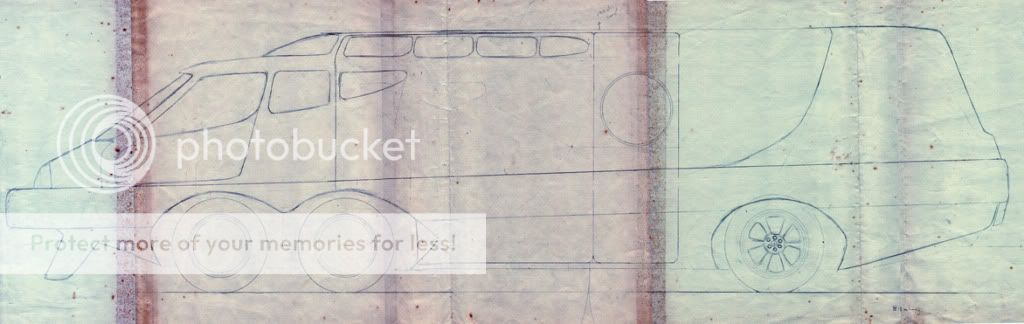
Mobile Home 1, circa 1974
This was my first attempt to design a mobile home that didn't look like an overinflated van or a box on wheels. Among other things it featured four front driven wheels, a truly huge windscreen and nice big bumpers for crash absorbing. Built in jacks would extend for parking and parts of it would expand to provide more room.

The weight of that huge windscreen was on my mind so I thought maybe you would have a second real safety glass one inside at a more reasonable size and angle, and the outer one would be lighter, thinner plastic just for the aerodynamic sleekness.
As you can see it was drawn on the center two pages from an exercise book as all my early drawings were. Unfortunately most of my early drawings are long lost, although some were sold to a friend on the schoolbus !
After careful consideration I reasoned that this vehicle would really be too small to live in so I started design work on a bigger machine, which will be seen next post.

The weight of that huge windscreen was on my mind so I thought maybe you would have a second real safety glass one inside at a more reasonable size and angle, and the outer one would be lighter, thinner plastic just for the aerodynamic sleekness.
As you can see it was drawn on the center two pages from an exercise book as all my early drawings were. Unfortunately most of my early drawings are long lost, although some were sold to a friend on the schoolbus !
After careful consideration I reasoned that this vehicle would really be too small to live in so I started design work on a bigger machine, which will be seen next post.
2011-11-13
RSO progress
This has taken a while, partly because I have been busy but also because it was a hard shape to make. The drive wheels are similar but not the same, so more work there.
Here is the background image with two pics of the finished part under it. Well, okay, it still needs a little tweaking.

Here is the background image with two pics of the finished part under it. Well, okay, it still needs a little tweaking.

2011-10-03
Microshots
These pictures were taken with a Microfilm camera many years ago. All I have done to them is alter the colour and clean up one or two blemishes.


 I like the way they turned out, all the texture from the copying process and the extreme contrast of the film have made the pictures much more interesting.


The Tracked Roadable Amphibian (TRA) project
This dates back to my early teen years as you can see by the faded pages torn from an exercise book.
I wanted to make something better than a conventional tracked vehicle – one that would really go anywhere and not destroy roads if used on them.
The basic idea was to design a single huge track that would have vertical axis hinges as well as the usual horizontal hinges of tracks. This would then be fitted to a frame with rollers, guide wheels etc. that would “bend” to enable cornering.
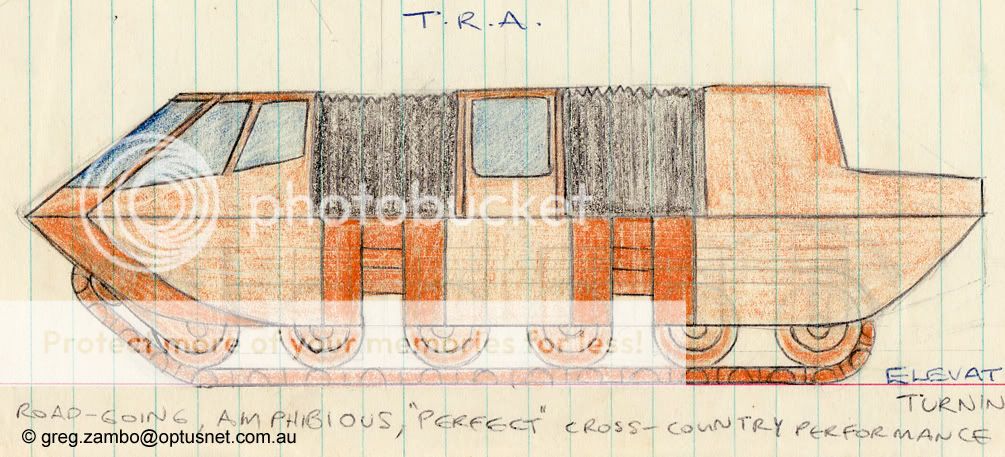 |
| [Side view of TRA mk.1] |
The main advantage of the design is that it would go over anything: mud, water, sand, anything: the whole bottom surface of it is tractive so the weight distribution will be lower than anything else by a major factor. This machine would cruise over sand dunes you can't walk on. Deep snow likewise.
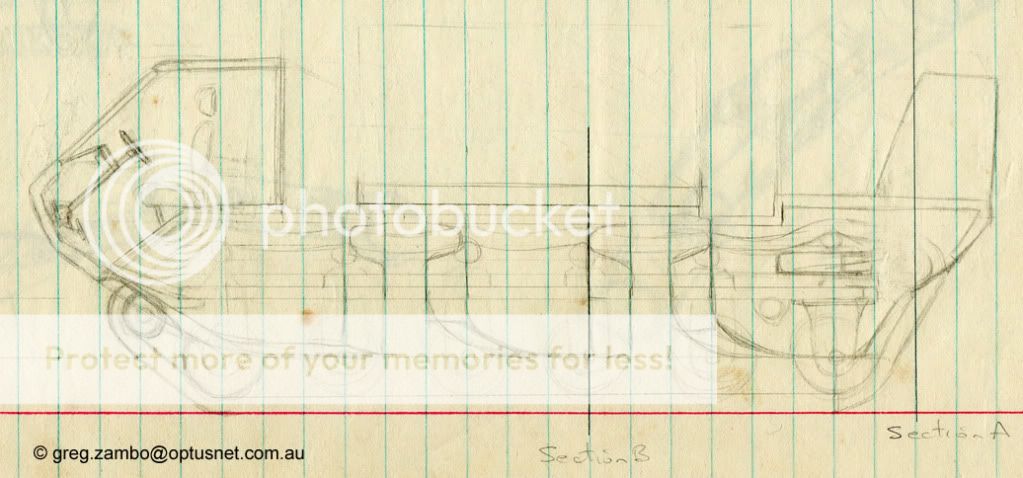 |
| [Side section of TRA] |
 |
| [Plan view showing cargo area and cabin] |
 |
| [Plan view of vehicle cornering] |
 |
| [Cross-section showing track wheels and drive system] |
There are problems with this idea: first, that track is going to be heavy. Even shaving weight with modern composites it will still be a significant mass in motion and that means more horsepower needed to move it: win some, lose some.
The next matter to consider is turning circle: I have tried to make it as tight as possible but there is a real limit to how narrow you can go. Ingenious overlapping plates on the ends of the track links would allow some tightening. You also need to provide a graduated turning system for perfect cornering: a corner should start at the front of the machine and progress to the rear (if you get the idea).
Suspension could be provided with the use of springing on the main wheels and some might also be provide by making the track links themselves springy - but too much in either area could result in failure of the track system.
Keeping the track on it's rollers and wheels could be a major issue since the track flexes in more than one plane: adding the shape changes of running over uneven ground and the need for a spring tensioner at one end of the track loop you are looking at some pretty fancy issues there - I still think it could be done though.
The TRA Mk.2
The Mk.1 design looked okay but the track seemed to take up a lot of space in the machine and I liked the idea of being able to lower the total weight and area used by using a sneaky design modification – so the Mk.2 was born.
My approach was to consider the track as a zigzag that could e either stretched out or compacted. In the stretched state the track feet attached to zigzag links by long arms would all fold into a narrow channel while also decreasing the overall weight of the track loop since the stretched section needs less links to go the same distance. On the front end a driven track pulley would pull the stretched links from the back and compact them into the wide layout for use underneath the vehicle. On the bottom of the vehicle, runners for the track would ensure that it stayed open.
The drawings show the basic idea but the design was never finished properly: unlike the simpler design, I was not happy with the second hinge axis problem created by this type of track.
 |
| [Mk.2 track shown extended] |
 |
| [Mk.2 track system in cross section with wheels and rollers] |
Now, I could mess with the part shapes in my 3D modelling software to improve or disprove the idea. Still there it is folks, anyone wants it, go ahead, just mention me somewhere okay?
Subscribe to:
Posts (Atom)